

Perpetual futures have become one of the most actively traded products in crypto. Hyperliquid has shown how large these markets can become on-chain. Options have followed a different path despite years of attempts to bring them on-chain.
We started looking into why this difference exists. The usual explanation is that options are more complicated than perpetual futures. But complexity alone doesn't explain why one market has attracted so much liquidity while the other continues to struggle.
Our view is that options face a different set of problems. They divide liquidity across many contracts and require more demanding trading infrastructure. Market makers also need efficient ways to manage the risks they take.
Hyperliquid makes this question worth revisiting because a deep perpetual market already exists. We wanted to understand whether this changes the economics of building an options market or whether the real difficulties remain elsewhere.
Why options struggle to build liquidity
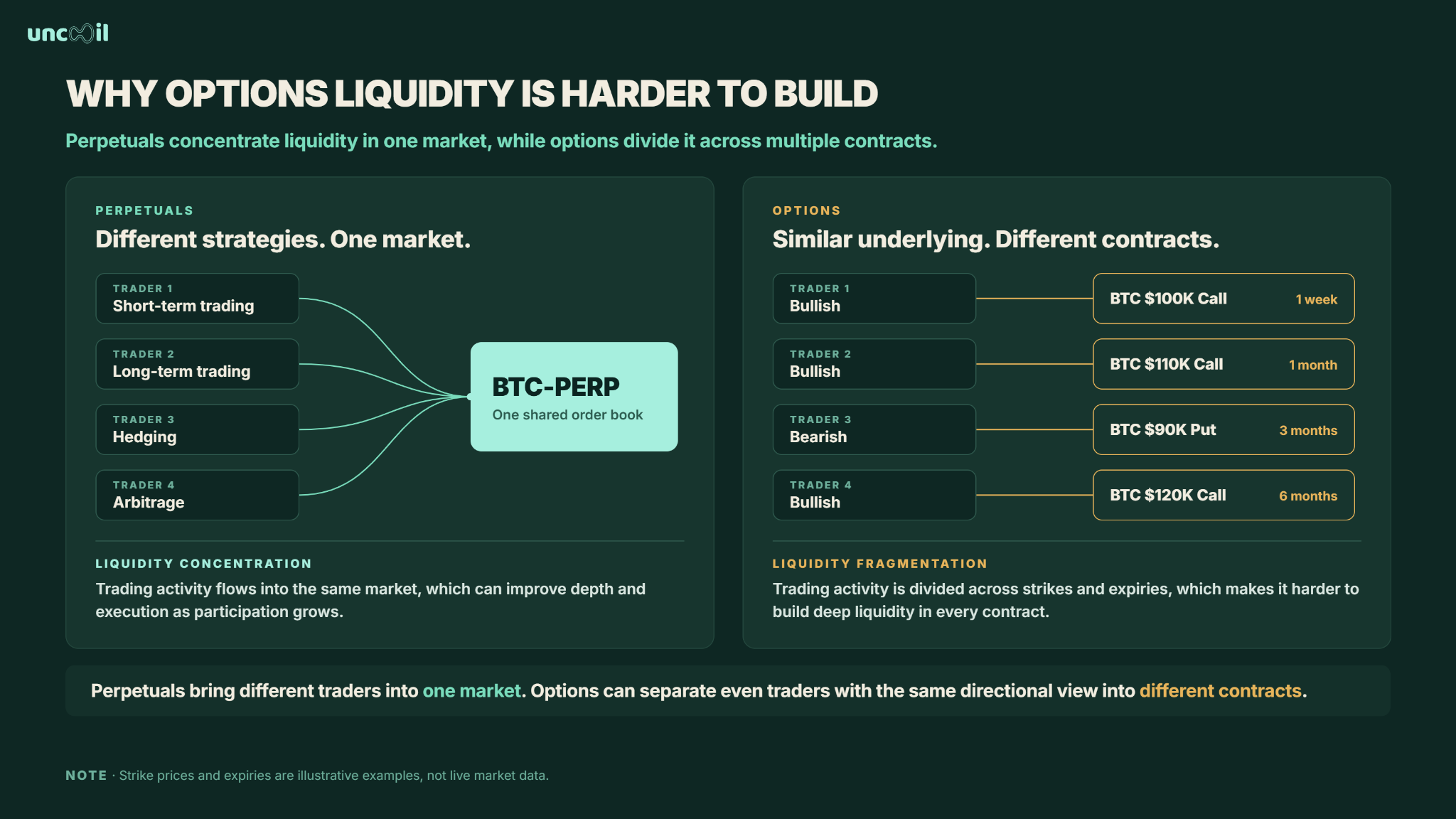
Perpetual futures have a natural advantage when it comes to liquidity. Someone trading BTC for a few minutes and another trader holding exposure for several weeks can both use the same BTC perpetual contract.
As more participants enter the market their activity contributes to the same order book. Market makers can often quote more competitively as trading opportunities increase. Better execution can then attract additional participants.
Options don't develop liquidity in the same way. Traders have to choose a strike price and expiry before entering a position. Even two traders with the same directional view may end up trading different contracts.
Every additional strike and expiry creates another market that needs liquidity. Popular contracts attract regular activity while others may trade infrequently. This makes it difficult to provide consistent execution across the entire options market.
Fragmentation also creates a technical problem. Market makers quoting hundreds of options need to update their prices whenever the underlying asset or expected volatility changes. During volatile periods these updates become more frequent.
An exchange may execute relatively few options trades while handling a much larger volume of quote updates and cancellations. We think this helps explain why options require more demanding infrastructure than perpetuals.
How On-Chain Options Evolved
Earlier on-chain options protocols tried different approaches to this problem. Ribbon Finance made options strategies accessible through vaults while Lyra attempted to provide continuous liquidity through an automated market maker.
Ribbon allowed users to participate in strategies such as covered call selling without trading individual options. Its vaults periodically sold options through auctions or other arrangements rather than maintaining a continuously liquid exchange.
Lyra approached the market differently by letting traders interact with an options AMM. The system priced options and managed trading exposure while using external derivatives markets for hedging.
Both approaches made options more accessible but faced different limitations. Vaults didn't provide continuous liquidity across contracts while AMMs had to manage capital requirements and hedging costs within developing infrastructure.
Lyra eventually evolved into Derive with greater emphasis on professional trading and capital efficiency. Its V3 upgrade in October 2026 moved custody to Ethereum while using off-chain matching and zero-knowledge verification for margin and settlement.
We think this evolution is important. The challenge was never simply making options available on-chain. It was building the infrastructure required to support competitive trading and professional market making.
The market underneath an options market
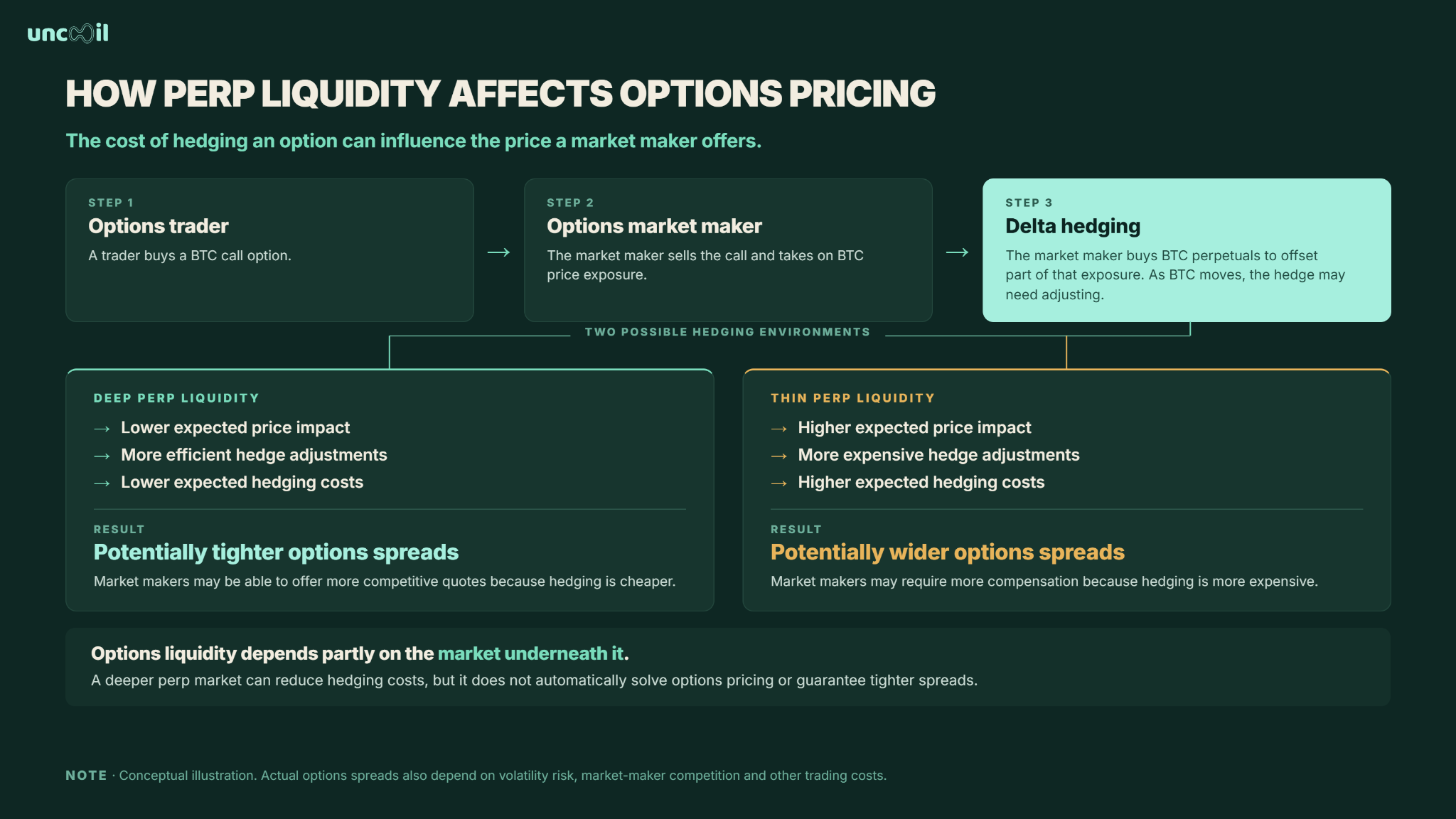
There is another part of options liquidity that deserves attention. When a market maker sells a BTC call option it takes on exposure to changes in BTC's price.
The market maker can reduce that directional exposure by buying BTC perpetuals. This is called delta hedging and it helps manage part of the risk created by selling the option.
The hedge doesn't remain constant because the option's exposure changes as BTC moves. Market makers may need to adjust their perpetual positions repeatedly throughout the life of the contract.
Every adjustment involves a cost. If the underlying market is relatively thin a large hedge can move the price against the market maker. Frequent adjustments can make those costs significant.
These costs influence the price a market maker is willing to offer. More expensive hedging can require additional compensation which may lead to wider options spreads.
This means options liquidity depends partly on another market underneath it. Even if an options venue attracts traders its market makers still need an efficient place to manage the exposure those trades create.
Our thesis is that having an established perpetual market can reduce this cost before an options venue reaches meaningful scale. Instead of developing both markets simultaneously the options venue can focus on the problems specific to options.
What Hyperliquid actually changes
Hyperliquid provides an existing perpetual market that options market makers can use for hedging. But the advantage depends on how efficiently options applications can access that liquidity.
Hyperliquid separates its infrastructure into HyperCore and HyperEVM. HyperCore handles the native trading markets while HyperEVM allows applications to interact with parts of that financial infrastructure through smart contracts.
Applications can read certain HyperCore data through precompiles and submit supported actions through CoreWriter. However some order actions through CoreWriter have additional latency and cannot be treated as equivalent to direct HyperCore execution.
This matters because options market makers need to adjust hedges quickly when prices change. Access to a deep order book is useful but the way an application connects to that order book can influence its actual hedging costs.
Synapse's Hypercall is exploring this architecture through an options-specific trading backend connected to HyperEVM and HyperCore. Its documented design separates matching and risk checks from the underlying perpetual markets used for hedging.
Derive V3 follows a different approach. It uses off-chain matching while keeping custody on Ethereum and applying zero-knowledge verification to margin and settlement operations.
Both approaches recognize that professional options trading requires fast execution alongside reliable financial controls. The difference lies in the underlying infrastructure and how the exchange manages the connection between trading and risk.
We think the important comparison is not which protocol lists more contracts. It is which architecture can provide competitive execution while reducing the cost of pricing and managing options risk.
The Infrastructure Problem
One argument is that earlier on-chain options couldn't scale because blockchain throughput was insufficient. There is some merit to this because options market makers need to update quotes across many contracts.
But not every quote update needs to become a blockchain transaction. Specialized matching systems can process orders quickly while smart contracts handle custody and settlement functions.
Professional market makers also rely on external pricing models and risk systems. They may trade options on one venue while managing exposure across several spot and derivatives markets.
An options exchange therefore needs reliable APIs and connections to those systems. Fast matching alone isn't particularly useful if market makers struggle to receive accurate data or execute hedges when they need to.
We don't think throughput was the only missing piece. The more important requirement is infrastructure that combines fast trading with efficient risk management and reliable settlement.
Why cheaper hedging isn't enough
Even with efficient execution and deep perp liquidity an options market still needs firms capable of pricing volatility. Hedging the directional exposure of an option doesn't tell a market maker what that option should cost.
Consider two BTC calls with the same strike price. One expires tomorrow while the other expires three months from now. The market maker has to account for the different amounts of uncertainty in those contracts.
A liquid BTC perpetual market cannot determine those prices. It can help manage directional exposure but doesn't establish how much traders should pay for volatility or protection over a particular period.
Options market makers also face risks that a perpetual hedge cannot remove. Changes in volatility affect option values while large price movements can require frequent hedge adjustments.
Capital efficiency creates another challenge. Market makers often hold related options positions that offset one another. Treating every position independently can make it expensive to quote across many strikes and expiries.
Portfolio margin can reduce this burden by considering the risk of positions together. Hyperliquid supports portfolio margin for eligible spot and perpetual positions but that isn't equivalent to a fully integrated options margin system.
Demand is the final part of the problem. For someone who simply expects BTC to rise a perpetual may be sufficient. Options become useful when traders want downside protection or exposure that behaves differently from a straightforward directional position.
These are meaningful uses but they don't automatically attract every perp trader. Better infrastructure can make options cheaper to trade without guaranteeing enough participants will want them.
Could Hyperliquid provide a common foundation?
There is another possible outcome worth considering. Rather than one application becoming the dominant options venue Hyperliquid could eventually provide more shared infrastructure that independent options builders can use.
HIP-3 offers an example through builder-deployed perpetual markets. HIP-4 introduced bounded outcome contracts although these are different from conventional options.
A similar approach for options could allow builders to compete on execution and product design while sharing more underlying infrastructure. That could reduce the need for each venue to develop its own settlement and collateral systems.
However conventional options require different margin calculations and settlement rules from perpetual futures. Supporting them through shared infrastructure would require additional mechanisms rather than simply extending the existing perp engine.
We see this as a possible direction rather than an announced development. The interesting question is whether the long-term advantage belongs to one options exchange or to the infrastructure that makes several exchanges easier to build.
The Bigger Picture
We started by asking why perpetual futures have scaled on-chain while options have struggled. Looking at earlier designs suggests the difference isn't simply that one product is more complicated than the other.
Options divide liquidity across many contracts and place greater demands on trading systems. Market makers also depend on efficient hedging and capital management which makes the surrounding infrastructure important.
Hyperliquid changes part of that starting point by providing an established perpetual market. This can potentially reduce hedging costs while allowing builders to focus on the systems specific to options.
But the approaches taken by Derive and Hypercall show that the outcome is far from settled. Both are addressing professional options trading through different combinations of execution and on-chain financial infrastructure.
Our view is that deep perpetual liquidity gives on-chain options a better chance of succeeding. The advantage only becomes meaningful if it translates into competitive spreads and reliable execution across strikes and expiries.
We would also look for sustained open interest and market-maker participation during volatile periods. Those would be stronger signs of a functioning options market than headline trading volume alone.
If options begin to scale around Hyperliquid it would support our view that an established hedge market was an important missing piece. If they continue to struggle the remaining problems may lie in volatility pricing and capital efficiency or in demand itself.
For now we think Hyperliquid has improved the starting conditions for on-chain options without guaranteeing their success. The real question is whether that advantage can make providing options liquidity economical enough to support a lasting market.