

On August 19, President Trump said CFTC Chairman Michael Selig was working to bring Hyperliquid into the United States in a “fully compliant and legal fashion.” Less than two weeks later, Bloomberg reported that Hyperliquid Labs was in advanced talks with Payward, Kraken’s parent company, on a structure that could make selected perpetual futures available to U.S. traders through Bitnomial. Any deal would still need regulatory approval, but the discussion has moved beyond whether perpetuals can exist in the U.S. The question now is what U.S. access could actually be worth to Hyperliquid.
Hyperliquid would not enter as a new venue trying to build its first order book. By late August, cumulative trading volume had reached roughly $5.27 trillion, with around 1.71 million registered users and $13.4 billion of open interest. Open interest had increased roughly 24% over the previous month, while Hyperliquid accounted for around 40% of perp DEX volume. Recent estimates also put annualized protocol revenue at roughly $748 million.
That is what makes the U.S. question interesting. Hyperliquid has already reached scale without direct American participation. I think the better way to measure the opportunity is not by counting how many Americans own crypto, but by looking at the trading flow Hyperliquid could realistically compete for.
A roughly $300 billion monthly market
CME is the obvious starting point. Its crypto futures and options complex averaged $10.3 billion of daily notional volume in July. But I would not count all of that as addressable. Options serve a different purpose from perpetuals, while part of the dated futures market exists specifically for basis trades, expiry-based hedging and other strategies that are unlikely to migrate to a perp.
To size the market, I started with CME, which averaged about $10.3 billion of daily crypto futures and options notional in July. Because that figure includes options, I treated roughly 80 to 90 percent as linear futures activity, then added Coinbase Derivatives and Kalshi’s recent perp volumes. That puts the addressable U.S. linear crypto-derivatives market at roughly $270 billion to $300 billion a month.
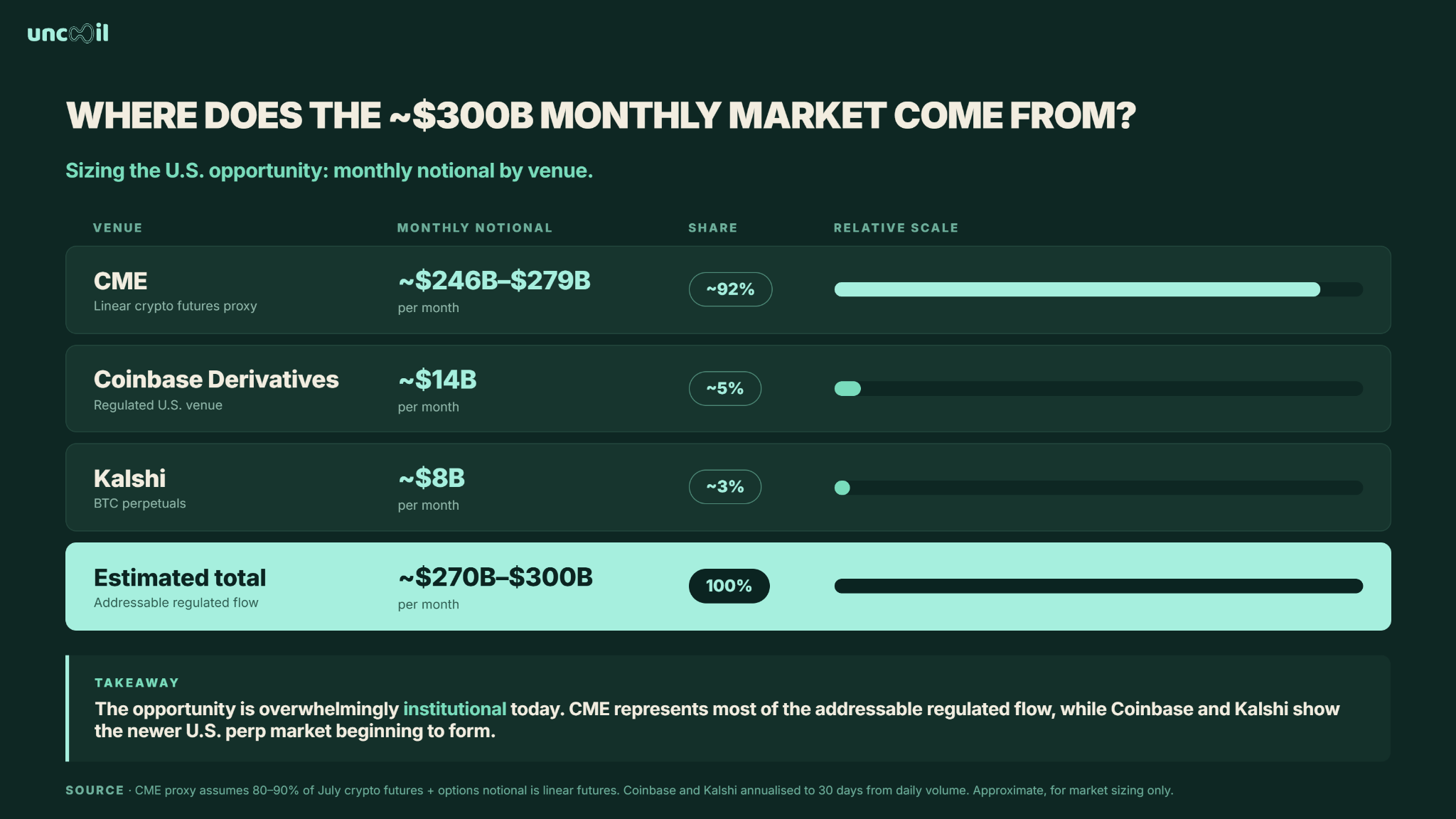
This is our estimate, not a reported market-size figure. On this proxy, CME still accounts for roughly nine-tenths of the activity, while Coinbase represents a much smaller regulated derivatives business and Kalshi’s bitcoin perp was running at about $270 million per day in July. Kraken has also entered the market through Bitnomial, giving U.S. traders another regulated route into perpetuals.
I have left spot trading out of the denominator. Spot is not directly substitutable with a derivative, so including it would inflate the opportunity. It still matters as a source of customers and collateral already sitting inside regulated U.S. exchanges, but I would treat that as distribution rather than TAM.
What could Hyperliquid take in year one?
My base case is 10%, with 5% as the conservative case and 15% as the aggressive one.
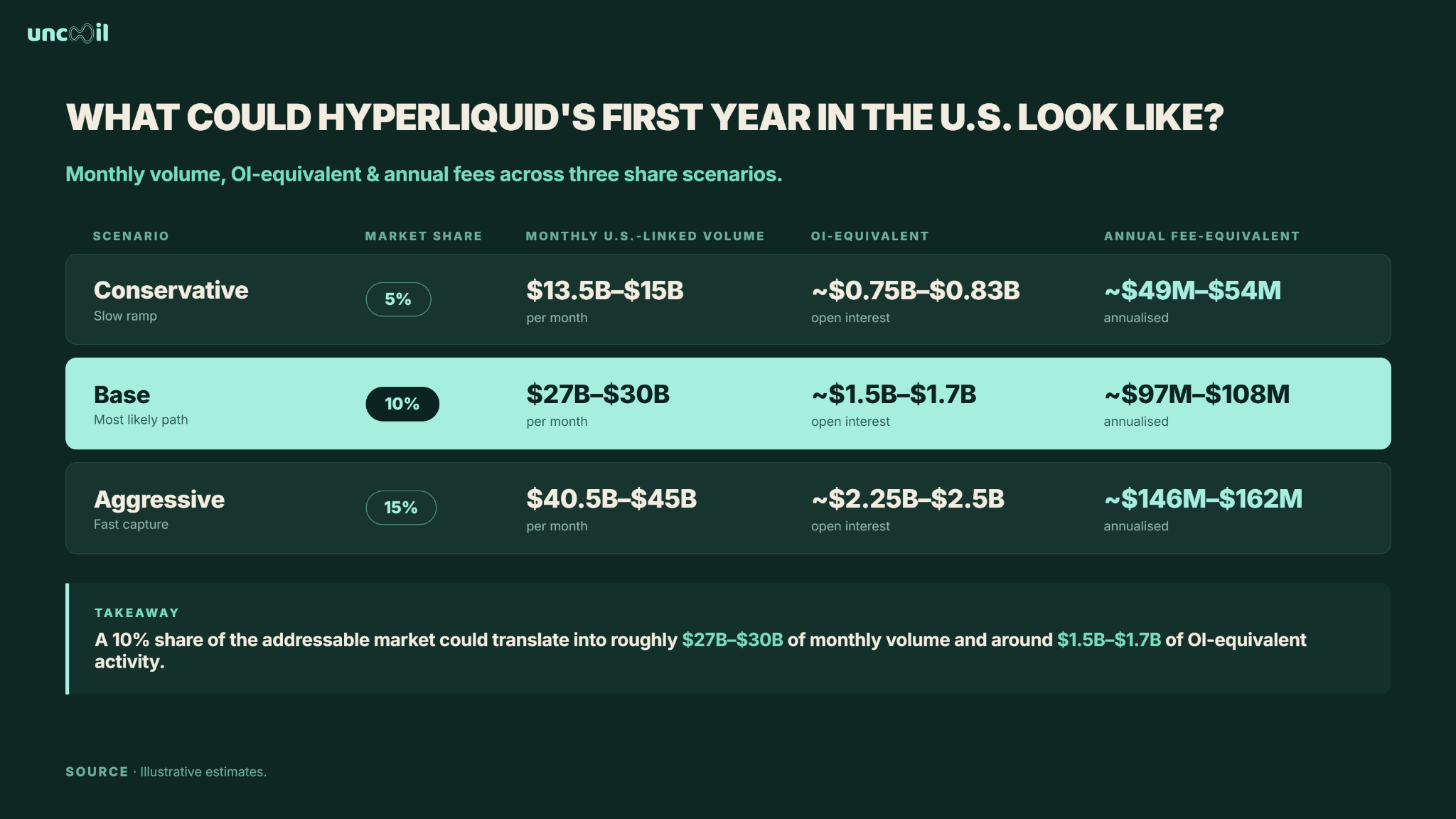
Ten percent is deliberately a little aggressive. What makes it defensible is that Hyperliquid already processed roughly $248 billion of perp volume over a recent 30-day period, which is close to the size of the entire U.S. market we are modelling. It also supports more than 100 perpetual assets and already has the traders and market makers that a new venue would normally spend years trying to attract.
I do not think the 10% comes mainly from replacing CME. CME has mature clearing relationships, portfolio-margin benefits and dated contracts that institutions need for specific hedging strategies. The more contestable flow is crypto-native: prop firms, market makers, directional funds, altcoin traders and professional accounts currently using offshore venues because regulated U.S. products are narrower.
Hyperliquid’s advantage is also no longer simply 24/7 trading. CME moved its crypto complex to continuous trading in May, while the newer U.S. perp venues are also built around continuous access. The stronger differentiation is product breadth, crypto-native execution, capital efficiency and the liquidity Hyperliquid has already built.
The bigger unlock may be professional capital
One useful read on the access problem comes from a January survey of 351 institutional decision-makers. 81% preferred spot exposure through a registered vehicle, and among firms planning to increase crypto holdings, 65% cited greater regulatory clarity as the main driver. That survey is not evidence of direct demand for Hyperliquid or perpetuals, but it shows how important the route into a market can be for institutions.
A fund can understand Hyperliquid and still be unable to trade there if its broker, custodian, risk team or compliance department cannot approve the venue. This is where Bitnomial changes the equation. Payward now owns a regulated futures commission merchant, designated contract market and derivatives clearing organization, and Kraken is already using that infrastructure to offer regulated U.S. perpetuals.
The first institutional Hyperliquid user in the U.S. may therefore never need to bridge USDC into a wallet and interact directly with HyperCore. The experience could look much closer to a conventional derivatives trade through regulated infrastructure. For me, that matters more than estimating how many additional retail wallets could appear. A relatively small number of professional accounts can generate a very large amount of turnover.
What does $30 billion mean for OI, fees and revenue?
Volume is only the first number. In late August, Hyperliquid was doing roughly $248 billion of trailing 30-day perp volume against around $13.4 billion of OI. That implies a monthly volume-to-OI relationship close to 18x. It is not leverage. It simply means that each dollar of average open interest supported roughly $18 of trading volume over the month.
If U.S. traders behaved similarly, the $27 billion to $30 billion base case could support roughly $1.5 billion to $1.7 billion of additional OI-equivalent activity. The 15% case would move closer to roughly $2.2 billion to $2.5 billion. These are estimates based on Hyperliquid’s current turnover pattern, not fixed forecasts.
Fees provide another way to think about economics. Hyperliquid’s base perp fee schedule starts at 4.5 basis points for takers and 1.5 basis points for makers, but fees decline heavily with volume and staking, while high-volume makers can reach zero fees or earn rebates. I therefore would not multiply U.S. volume by the headline taker fee.
Using 3 basis points as an illustrative blended fee rate, the 10% case would generate roughly $8 million to $9 million of monthly fee-equivalent activity, or around $97 million to $108 million annualized. Using Hyperliquid’s recent revenue-to-volume run rate as a second reference puts the same base case at roughly $80 million to $90 million of annual protocol-revenue equivalent.
Neither figure should be read as revenue that automatically goes to Hyperliquid Labs. A Bitnomial structure could divide economics between the regulated venue, intermediaries and Hyperliquid differently. The calculation tells us what the flow could be worth at current Hyperliquid economics, not what the final commercial agreement will look like.
There is a potential HYPE effect as well. Hyperliquid’s native fee system directs fees to the community, with the Assistance Fund automatically converting its allocation into HYPE and burning it. U.S. volume would only strengthen that mechanism if the eventual structure actually feeds economics back into the native fee system.
U.S. volume is not automatically HyperCore liquidity
This is the distinction I think matters most. If Hyperliquid-linked products reach $30 billion of monthly U.S. volume, it does not mean $30 billion suddenly trades on HyperCore.
The structure currently being discussed points to Bitnomial as the regulated U.S. venue. Its existing perpetuals trade through Bitnomial’s regulated infrastructure, and nothing publicly disclosed so far says U.S. orders would execute directly against HyperCore’s existing order books.
The two markets can still connect economically. A market maker carrying exposure on Bitnomial could hedge it on HyperCore, while arbitrageurs can trade differences between the two venues. If even half of the $27 billion to $30 billion base case eventually produced related hedging or arbitrage activity on HyperCore, that would represent roughly $14 billion to $15 billion of additional monthly flow. The 50% assumption is illustrative, but it shows why the final plumbing matters.
A separate U.S. order book gives Hyperliquid distribution. A structure that also connects professional U.S. flow back to its existing global liquidity would be far more valuable.
The legal path is already taking shape
The CFTC has already created two useful precedents. In May, it approved Kalshi’s BTCPERP as a U.S.-listed futures contract. On the same day, CFTC staff confirmed that certain Deribit perpetuals could be treated as foreign futures when offered through Coinbase Financial Markets under specified conditions.
The reported Payward talks suggest another practical route: selected Hyperliquid-linked products could use an existing regulated U.S. derivatives stack instead of Hyperliquid having to recreate one from scratch.
That does not mean every Hyperliquid market comes with it. Crypto perps currently have the clearest regulatory route. Futures on individual stocks are security futures products subject to joint SEC and CFTC oversight, so equity-linked HIP-3 markets would face a different set of requirements.
My base case remains a 10% first-year share, or roughly $27 billion to $30 billion of monthly U.S.-linked volume. At current Hyperliquid trading behaviour, that could correspond to roughly $1.5 billion to $1.7 billion of OI, around $100 million of annual fee-equivalent activity, and potentially meaningful additional HyperCore flow.
I do not think Hyperliquid gets there by replacing CME. The more realistic opportunity is to take a slice of professional crypto-native flow, give offshore activity a regulated route back onshore, and open its markets to institutions that could not previously access them directly.
Hyperliquid has already shown how large it can become without America. What matters now is how much American capital it can bring in, and how much of the product that created its existing liquidity can survive the regulatory wrapper.